
The Brain: Branching nerve fibers form a dense network in the brain. The large object (top right) is a cell body with fibers leading out from it. All around are outgrowths from other brain cells. Each nerve cell
in the brain can fire a very small electrical pulse, and does so according
to inputs received from other nerve cells. Individual pulses are weak --
the entire brain only creates about 20 watts of power -- but each firing
has to be sufficient to energize the next cell, or group of cells. Signal
transmission from one cell to another is achieved chemically rather than
electrically, with a chemical known as a neurotransmitter released at each
nerve ending. The transmitter crosses the synapse (gap) to the next neuron
and becomes lodged in a specific receptor site. This then activates a chain
of events in the second neuron which causes it to fire and thus pass the
impulse along. The passing of an impulse enables us to remember faces,
think consciously and behave with intelligence.

Organ of Balance: The vestibular apparatus in the inner ear. The red crystal at the bottom forms part of the 'ear dust'; these crystals help humans adjust to gravity. Learning to walk
not only requires appropriate nerve connections and musculature, but also
balance. The organ of balance -- the vestibular apparatus or labyrinth
-- exists within the inner ear. It consists of two distinct systems. Firstly,
there are three semi-circular canals, each filled with fluid and each set
in a different plane. All three act as a receptor system, with the contained
fluid accelerating or decelerating, enabling the brain to detect and record
head movement. Secondly, there are the saccule and the utricle. These also
work in a mechanical fashion. They possess chalky particles (otoliths or
ear dust) which respond to gravity. The particles come to rest upon sensitive
hairs, enabling the organ's owner to know which way is up and which is
down. These two systems permit balance to be achieved.

Teeth: After a child's milk tooth becomes loose and falls out, the permanent tooth begins to emerge, a process that can be seen in this seven-year-old's mouth. Teeth are formed
from the skin, the enamel originating from the outer layer or epidermis
and the inside of the tooth from the dermis. The milk (baby) teeth begin
to form in the foetus at around seven weeks post-conception. Ten weeks
later they are fully d eveloped in the jaw, and the buds of the permanent
teeth have started to form behind them. The buds for the permanent teeth
lie dormant until they start to grow in the sixth

Heart Disease: Close-up of a blood clot with red blood cells caught in the fibrous mesh. The coronary arteries
are susceptible to the build-up of fatty deposits, a process that can start
in childhood but becomes significant in middle and old age. Age also causes
the artery walls to become thicker and less elastic -- a process known
as arteriosclerosis. The fatty deposits accumulate cells and connective
tissue and consolidate into hard plaques called atheroma, which partially
block the artery. The combination of these two conditions is termed atherosclerosis,
and is the precursor to heart attack and angina. Once the arteries around
the heart narrow, there is a danger that they will become blocked. A piece
of plaque is dislodged, further obstructing the flow, and a blood clot
forms around it. Such a blockage is known medically as a myocardial infarction:
in common terms, a heart attack.
Cancer: Two cancer cells (shown in blue) that have just divided. Cancer cells tend to have uneven surfaces and may use the outgrowths for movement. The pink objects are white blood cells. Death and renewal
are kept in balance by genetic instructions governing cell behavior. In
cancer, the system of regulation breaks down, and cells begin to divide
uncontrollably. Sometimes the process is rapid, and sometimes it may take
10, 20 or 30 years, but eventually the cancerous cells build up to form
a lump known as a tumour or neoplasm (meaning 'new growth'). As the tumour
grows, capillaries form around it to supply it with blood, probably in
response to chemicals secreted by the tumour cells. Instead of performing
a useful function, the cancer tissue greedily absorbs nutrients at the
expense of the neighboring tissues. If the tumour is on a vital organ,
disruption of the organ's functions can lead to death.

The First Six Weeks: The embryo is recognizably human in appearance, and sex differences are now becoming visible. At six-weeks-old,
all of the embryo's major organs are now present in rudimentary form. Its
fingers are separated, but its toes are still only outlines. It has marked
skeletal growth, but its skeleton is still cartilage, not bone. The embryo's
complete intestinal tube is formed, and male/female differences are becoming
visible.
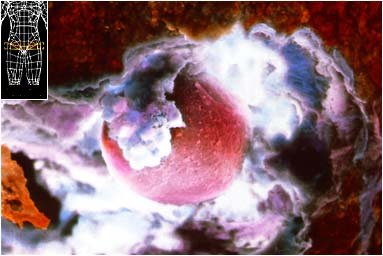
Ovulation: The follicle ruptures, and the egg is expelled. After floating across a small gap, it enters the fallopian tube or oviduct. For girls, by
far the most significant event of puberty is menstruation, the rhythmic
pattern of events that controls female fertility. At its root is the monthly
ripening and release of an egg from the ovary. Ovulation is caused by a
surge in the production of luteinising hormone (LH) by the pituitary gland
in the brain. Levels of LH and follicle stimulating hormone (FSH) begin
rising from the first day of menstruation. FSH causes a number of egg follicles
to begin ripening, and in turn the ovary steps up its secretion of the
hormone oestrogen. Two days before ovulation, the pituitary steps up it
hormone output, and the ovary responds by switching some of its secretion
from oestrogen to progesterone. At the same time, the most mature of the
ripening egg follicles ruptures to release its ovum, while the rest of
them die off.
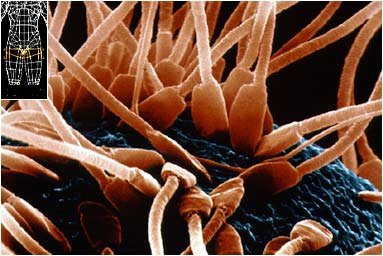
Fertilisation: The sperm are attracted to the thick surface of the egg and penetrate it head first as shown here. Once in the vicinity
of the egg, the sperm are chemically attracted to it. When they reach their
destination, they must first penetrate the corona radiata before the outer
membranes of their heads bind to special receptors in the egg's thick outer
covering. Each sperm's store of protein-dissolving enzymes is then released,
allowing its head to burrow downwards towards the egg cell itself, a journey
taking about 30 minutes. Many sperm take part in this disrobing process,
helping the eventual victor on its way. When the first sperm encounters
the egg, the outer membranes of the sperm and egg fuse, and chemical changes
in the egg rapidly prevent any more sperm from entering.

Sweat Glands: Electron microscope image of a sweat pore. Sweat is secreted by sweat glands within the skin and emerges through the pores. Linked to the
production of adult odors at puberty is a change in the pattern of sweating.
Humans have two types of sweat glands, each with very different functions.
The eccrine glands are found all over the body and produce a faintly acid,
watery fluid containing less than 2% solids. The evaporation of this fluid
from the skin helps to keep the body cool. In contrast, the apocrine glands
are located in the armpits, naval, ears, nipples and pubic zone. They secrete
a thick, waxy, grayish substance that is diluted by fluid from other glands
nearby. The apocrine glands do not become fully functional until puberty.
They have no role in temperature regulation but are related to the scent
glands of animals, and are thought to function solely for odor secretion.
They are not stimulated by heat but by stress and emotion, including sexual
excitement.

Blood and Circulation: A cross-section through an artiole (a very small artery). Its muscular wall contracts and expands, thus regulating arterial blood pressure. Red blood cells can be seen traveling through it. Humans and all
mammals have what is known as double circulation, meaning that blood passes
through the heart twice. On the first pass it is sent to the lungs to collect
oxygen and get rid of carbon dioxide. From there it returns to the heart
and is pumped at high pressure out into the arterial system. The arteries
are elastic in order to cope with the surge of blood. As we age they become
stiffer, causing the blood pressure to rise and making the heart work harder.
B r a i n P o w e r
It is the human brain that has got our species where it is today. Together with a clever hand and the ability to speak, both of which need a good brain, it was the dramatic evolution of humanity's cerebral hemispheres that permitted this single species to become the most accommodating, wide-ranging, intelligent, vociferous, creative and potentially destructive species the world has ever known. Three million years ago the biggest brain among our ancestors measured 450 cubic centimeters (equivalent to that of modern chimpanzees and gorillas). Average modern brains are closer to 1,400 cc for males and 1,250 cc for females. In proportional terms the smaller female brain forms 2.5 percent of the body, while the bigger male brain makes up 2 percent. Many animals have even better body/brain ratios: In some monkeys, it is closer to 5 percent. And various animals have bigger brains than humans — elephants (four times as big) and sperm whales (six times larger), for example. But brain function is not dictated solely by size. Some intelligent humans have brains twice the weight of other intelligent humans. The human brain is still a fairly diminutive part of the body, despite its massive size increase over the course of evolution. Size (and weight) of brain tissue is less important than the degree of convolution. Such folding, causing ridges and grooves, leads to a greater surface area, and this is highly relevant to the brain's ability. So too is neural organization, the interconnections between the millions of nerve cells within the 1.4 kilograms of human brain. These cannot be mapped in a living brain, and there is no way — yet — of discovering even in a dead brain where its former owner would have rated on the IQ scale. The brain is divided into distinct structures, all with different roles. At the base of the brain, above the spinal cord, is the brain stem. This area controls involuntary movement, posture and all the subconscious tasks required for the general maintenance of life. Above the brain stem is the cerebrum, or forebrain, which includes the highly enlarged cerebral hemispheres. These hemispheres
are, in essence, where Homo sapiens resides. Most of the brain's
appetite for oxygen is generated here: The hemispheres are 16 times more
demanding, by weight, than any other tissue. They are separated from each
other by the longitudinal fissure, linked only by a thick bundle of nerve
fibers running from one side to the other. The cerebrum, in particular
the cerebral hemispheres, is the part of the brain that most distinguishes
humans from animals. It was this portion that enlarged so dramatically
from early to modern humans.
During a lifetime, an average human being will:
|

